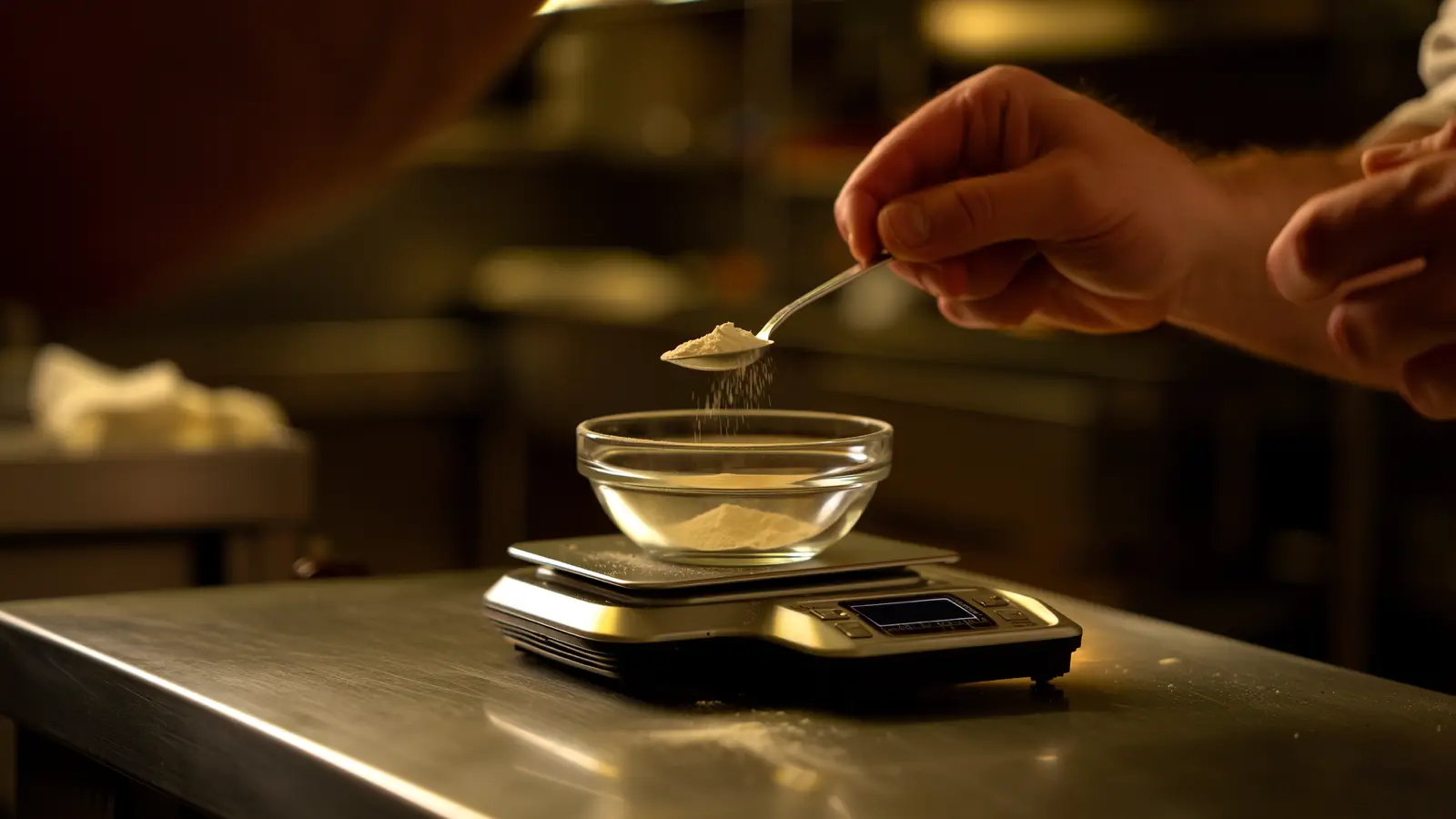
Ask a home cook to measure a cup of flour and you'll get a number that can vary noticeably depending on technique and flour type — packed versus spooned can shift the real quantity by a meaningful margin. Ask a line cook to weigh 140 grams and you'll get 140 grams, every time, from anyone who picks up the scoop. That's the entire reason professional kitchens weigh almost everything and home kitchens don't: reproducibility, not fussiness.
Volume measures the container, not the ingredient
A cup, a tablespoon, a scoop — all of them measure how much space something takes up, and space is exactly what compresses, settles, and varies with humidity, particle size, and how the ingredient was handled before it hit the measure. Flour packed into a cup weighs meaningfully more than flour spooned in loosely; the recipe that says "one cup" hasn't actually specified a quantity, it's specified a range.
A gram is a gram, on any scale, in any kitchen
Weight doesn't compress or settle. 140 grams of flour is 140 grams whether it's sifted, packed, or poured straight from the bag, and it's the same 140 grams on a scale in a different kitchen, on a different shift, under a different cook. That reproducibility is the entire point — a recipe measured by weight behaves the same way twice, which is the minimum bar for something you're going to cost and sell at a fixed price.
Reproducibility is what makes a fiche technique costable
A fiche technique only means something if the dish it describes actually comes out the same way every time it's made — otherwise the cost on paper and the cost on the plate drift apart depending on whoever's on the line that shift. Weight-based recipes are the foundation that makes a recipe spec worth writing down at all; a volume-based one is closer to a suggestion than a standard.
Why grams and millilitres aren't interchangeable
A gram measures mass; a millilitre measures volume — and the two only convert directly for water, because water's density happens to be 1. Everything else — oil, honey, flour, alcohol — has its own density, and swapping grams for millilitres without accounting for it quietly shifts every quantity in the recipe. It's a small conversion factor, but skipping it is exactly how a scaled recipe stops tasting like the original.
None of this needs a lab — a decent digital scale and the habit of weighing instead of scooping gets a kitchen most of the way there. The full conversion reference, including the g/ml factors by ingredient, is in the kitchen conversions guide; the yield side of the same problem — what the invoice weight becomes after trim — is in the kilo you bought isn't the kilo you serve.