Double a recipe and the ingredients scale cleanly — twice the flour, twice the butter, twice the sugar. Double the salt the same way and the dish is often over-seasoned; double the cooking time and the centre is raw while the edges burn. Scaling isn't one operation, it's several, and only one of them is actually linear.
What scales linearly: the ingredients
Most ingredient quantities scale by a straightforward factor — multiply everything by the ratio between your target yield and your current one, and the base recipe holds. Ten portions to forty is a ×4 factor, applied line by line down the ingredient list. This is the easy 90% of scaling, and it's genuinely reliable for the bulk of a fiche technique, provided every quantity is weighed rather than eyeballed to begin with.
What doesn't: seasoning, spice, and time
Salt, chili, acid, and strong spices don't scale linearly — a pinch that's right in a single portion becomes an overwhelming amount at ×10, because seasoning is tuned to surface area and palate, not raw volume. Treat the ×factor as a starting point for seasoning, then taste and adjust at the new scale, every time. This is a rule of thumb, not a formula, and it's the step that separates a scaled recipe from a ruined one.
A quick example
A sauce built for ten portions calls for 2g of chili flake. Scaled ×4 on paper, that's 8g — but tasted at the new batch size, 6g often reads as equally hot, because surface area and dilution don't scale the same way flavor perception does. The arithmetic gets you close; the tasting spoon gets you right.
What else moves: yield, evaporation, and pan geometry
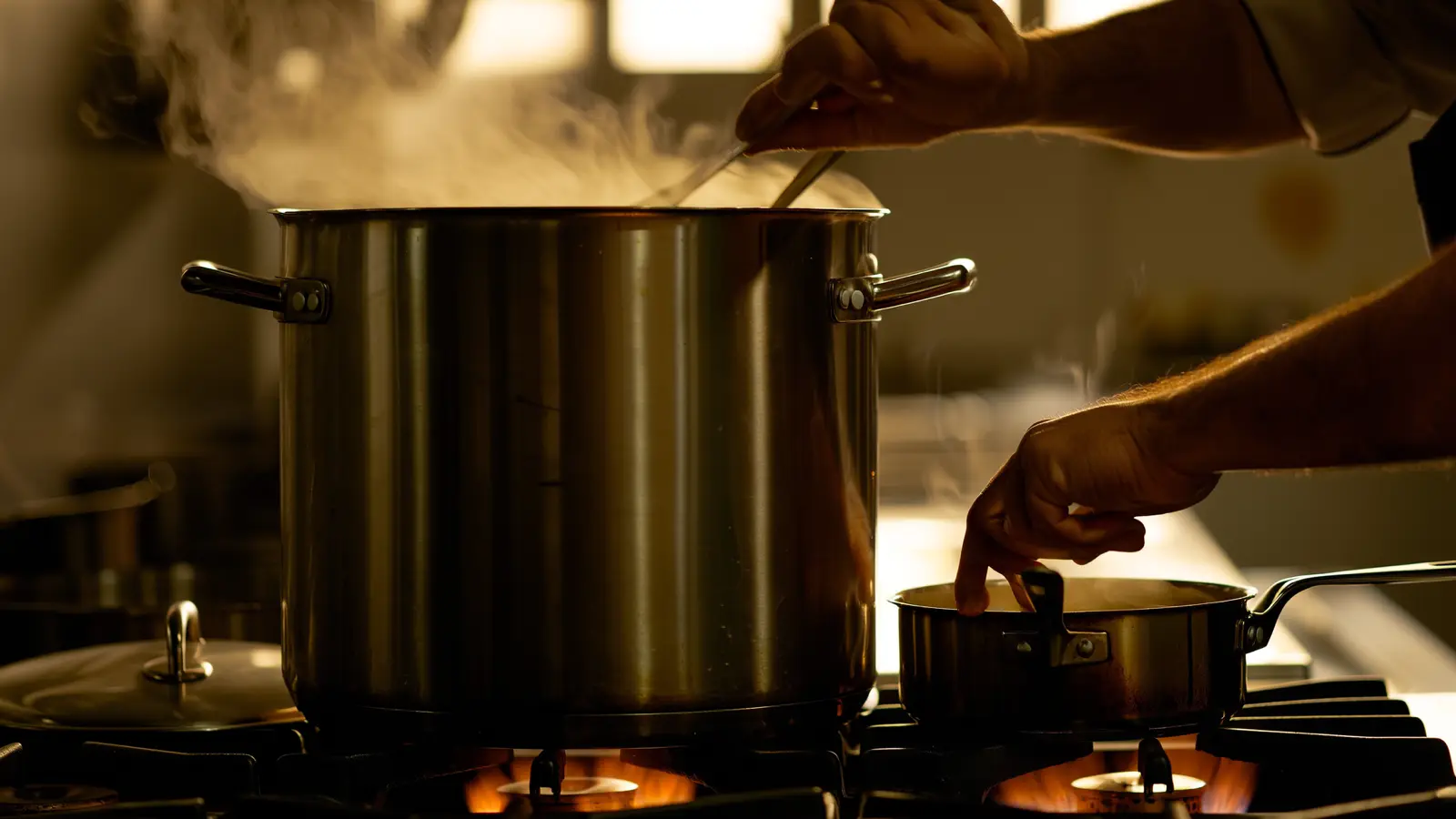
A sauce reduced in a wide, shallow pan evaporates faster than the same volume in a narrow, deep one — scale the recipe ×4 without accounting for pan surface area and the reduction time, and the final yield, shift in ways the ingredient list alone won't predict. Batch cooking changes physics, not just arithmetic: bigger batches often need re-testing for time and yield, not just multiplication.
The method that actually works
Calculate the ×factor from ingredients first — that part is genuinely mechanical. Then re-test the batch at the new scale before it goes on the menu: taste for seasoning, check the actual yield against the theoretical one, and time the cook again rather than trusting the multiplied number alone. A scaled recipe that's never been tasted at scale is still a guess wearing a fiche technique's clothing.
The weight side of this — why measuring by grams instead of volume is what makes any of this reliable in the first place — is in why pro kitchens weigh everything. The AP/EP side — why the weight you started with isn't the weight that ends up on the plate — is in the kilo you bought isn't the kilo you serve. The reference tables and the ×factor tool are in the kitchen conversions guide.