The recipe spec sheet template that keeps its own costs current
The full template — exact measures, method, allergens, food cost — and the way to make your spec sheets live at the pass and behind the bar on a busy night, not die in a binder nobody opens. Download the example, or build your own in 35 seconds.
14-day trial · No credit card · Cancel anytime
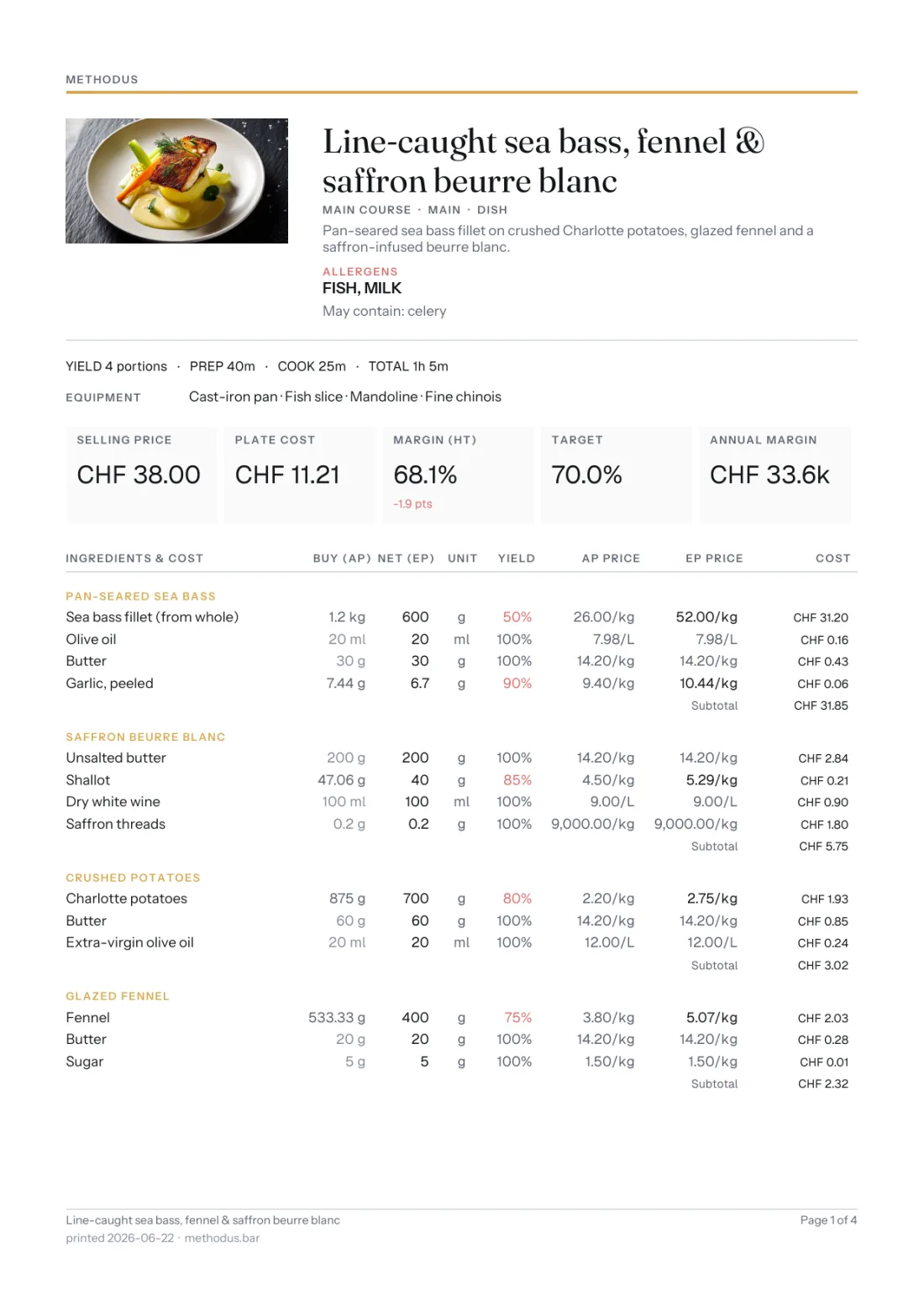
A real dossier exported from Methodus — not a mockup.
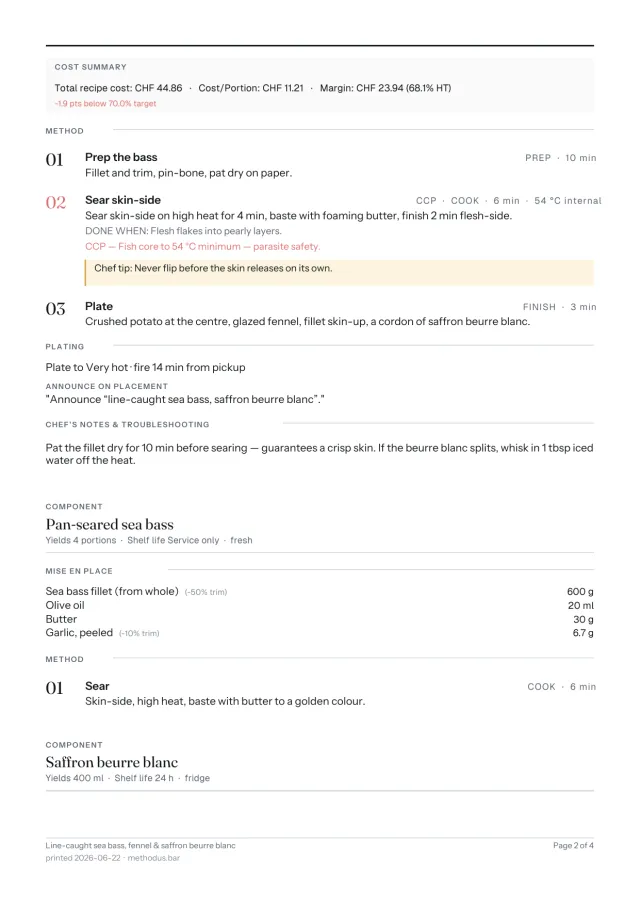
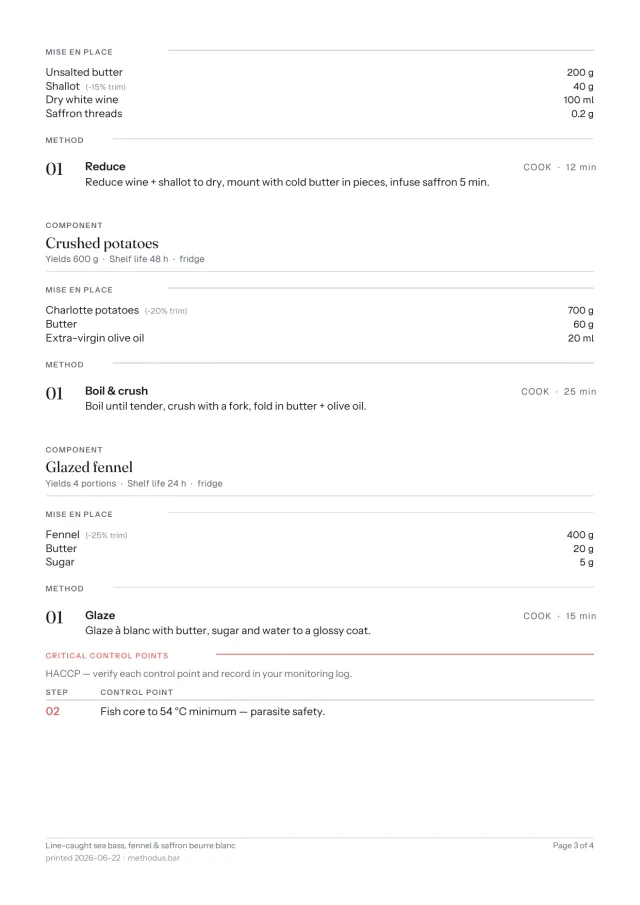
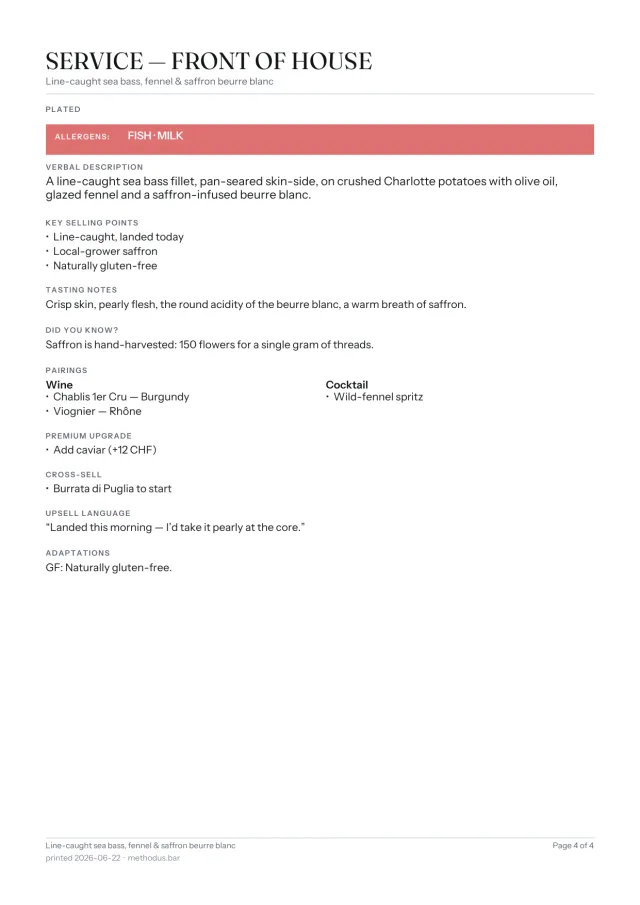
All 4 pages: costed recipe · method & plating · components & controls · front-of-house service sheet.
What every recipe spec sheet needs
A spec sheet does three jobs at once: consistency (the plate comes out the same on any station), safety (allergens don't travel by word of mouth), and margin (food cost is read, not guessed). The four blocks:
1.Identification
- Recipe name
- Category (starter, main, cocktail…)
- Number of portions / glass size
- Photo of the plating or the service
2.Ingredients & measures
- Every ingredient with its exact weight or measure
- Clear unit (g, oz, each)
- Unit purchase price and cost per portion
- Trim and yield loss counted (gross → net)
3.Method
- Numbered steps, one action each
- Control points (texture, temperature, balance)
- Specific equipment
- Plating: the plate or glass that leaves the pass
4.Safety & costing
- Allergens (the 14 required in the EU — INCO regulation; your local list elsewhere)
- Storage and use-by date
- Total food cost and cost ratio (%)
- Suggested selling price
Example: a Negroni spec sheet
INGREDIENTS
- London Dry Gin1 oz
- Campari1 oz
- Sweet vermouth1 oz
- Orange peel1
ALLERGENS
Sulfites (vermouth)
METHOD
- Rocks glass over one large ice cube
- Add the three parts, in order
- Stir 15 seconds with a bar spoon
- Express the orange peel, drop it on the ice
Food cost
$2.18
Pour cost at $14.00
15.6%
This cost is right today. Tomorrow your supplier moves the price — and a static PDF starts lying. See below how the cost follows the invoice instead.
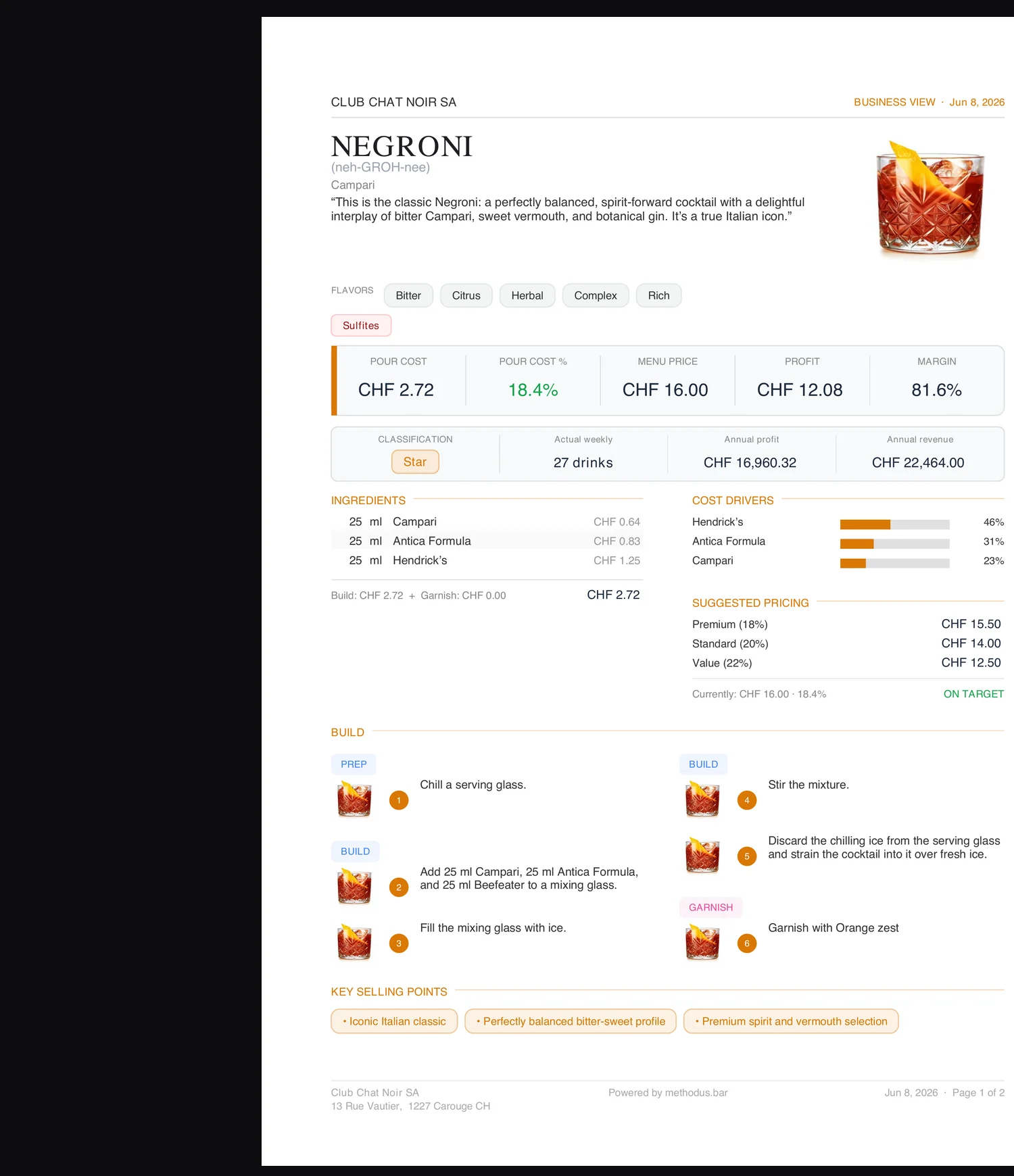
A real Negroni spec sheet, exported from Methodus: pour cost, margin, build and sensory profile on one page.
The gap is small. The leak isn't.
The gap between what you think a plate costs and what it really costs runs 5–20%. Drag your numbers and watch what it quietly takes off your margin.
Most venues sit around 10%.
F&B runs thin — often 5–10%.
a year — ≈ 42.9% of your net profit.
Margin you already earned — you just can't see it yet.
Gap range: Sculpture Hospitality · Restaurant365
Why spec-sheet binders die
I spent years in kitchens and behind the bar rebuilding the same binder. Right the day I printed it, out of date the week after: a supplier moves a price, the menu changes, and nobody opens it on a busy Saturday night. The know-how goes back into people's heads — and it walks out the door with whoever carried it. A spec sheet only keeps its promise if it lives where the team works: on a screen at the pass and behind the bar, with costs that follow the invoices.
Bars drift up to 20% of their liquor inventory (Sculpture Hospitality); kitchens run 3–5% between theoretical and real food cost (Restaurant365). Outdated spec sheets are where the leak usually starts.
Nobody has time to fill in spec sheets. To dictate them, yes.
The chef or head bartender talks through the recipe — 35 seconds on the phone — and the spec sheet comes out complete: measures, method, allergens, food cost from your real purchase prices. The team reads it mid-service, and it stays current with every invoice you scan.
Scan an invoice, the cost updates itself
Import a supplier invoice and confirm your ingredients — every spec sheet that uses them re-costs automatically. The $2.18 above never goes stale.
The starting point for the math: food cost calculator →
Spec sheets and HACCP: allergens (the 14) and control points
A spec sheet is the first written link in your HACCP process: it's what puts a recipe's allergens and station control points on paper, dish by dish. In the EU, the INCO regulation (No 1169/2011) requires information on 14 major allergens — an obligation you meet recipe by recipe, never by word of mouth. Elsewhere, use your local allergen list.
- The 14 allergens from Annex II of the INCO regulation, filled in on every spec sheet from the ingredients — no list forgotten on a busy night.
- The recipe's control points (core temperature, texture, secondary use-by) written at the step where they matter.
- Traceability that follows: when an ingredient changes, its allergen updates on the spec sheet, not in a stale binder.
Methodus documents allergens and control points at the recipe level — and the SOP module keeps the rest of the daily routine: scheduled checks, temperature logs with photo proof, label-scan traceability. The full method: HACCP for restaurants →
 Who builds methodus
methodus is built by an operator. Nathaniel Gilliand, École hôtelière de Lausanne graduate, runs restaurants, bars and beach clubs. This is the tool he built to find the margin that was evaporating in his own P&L.
14-day trial, no credit card.
Frequently asked questions
It's a free template — why pay for Methodus?
The template gives you the structure. Methodus fills it in for you: dictate the recipe, the spec sheet comes out costed, and it stays current when prices move. A PDF is something you rebuild by hand every time the menu or a supplier price changes.
Is this just for bars?
No. Methodus is for the whole house — kitchen, bar, cellar, and floor. The template works for a plate as well as a cocktail.
Is a spec sheet required for HACCP?
A spec sheet isn't mandated as such, but it's the natural home for your obligations: information on the 14 allergens (INCO regulation), control points and traceability. In practice it's the document your HACCP process rests on, recipe by recipe.
Are the 14 allergens mandatory?
In the EU, yes — the INCO regulation requires information on 14 allergens. Methodus fills them in automatically from your ingredients, on every spec sheet. Elsewhere, use your local allergen list.
How do I manage allergens on my spec sheets?
Methodus fills in the 14 allergens from Annex II of the INCO regulation automatically, from each recipe's ingredients, and updates them when an ingredient changes. The information stays correct on the sheet, with no re-entry every time the menu evolves.
Do my recipes and costs stay mine?
Yes. Your data is yours — export to PDF anytime, deletion on request. Nothing is shared.
How long does setup take?
A few minutes. You dictate your first recipe in 35 seconds, no typing, from any phone.
Do I need a credit card for the trial?
No. 14-day free trial, no card. Your spec sheets stay if you continue.
Your next spec sheet, dictated tonight.
Take back control of your costs. The first spec sheet takes 35 seconds.
14-day trial · No credit card · Cancel anytime
Your recipes and your costs are yours — export anytime.
Cookies & measurement. Essential cookies run methodus.bar. Analytics & ads only with your OK. Details in the privacy policy.