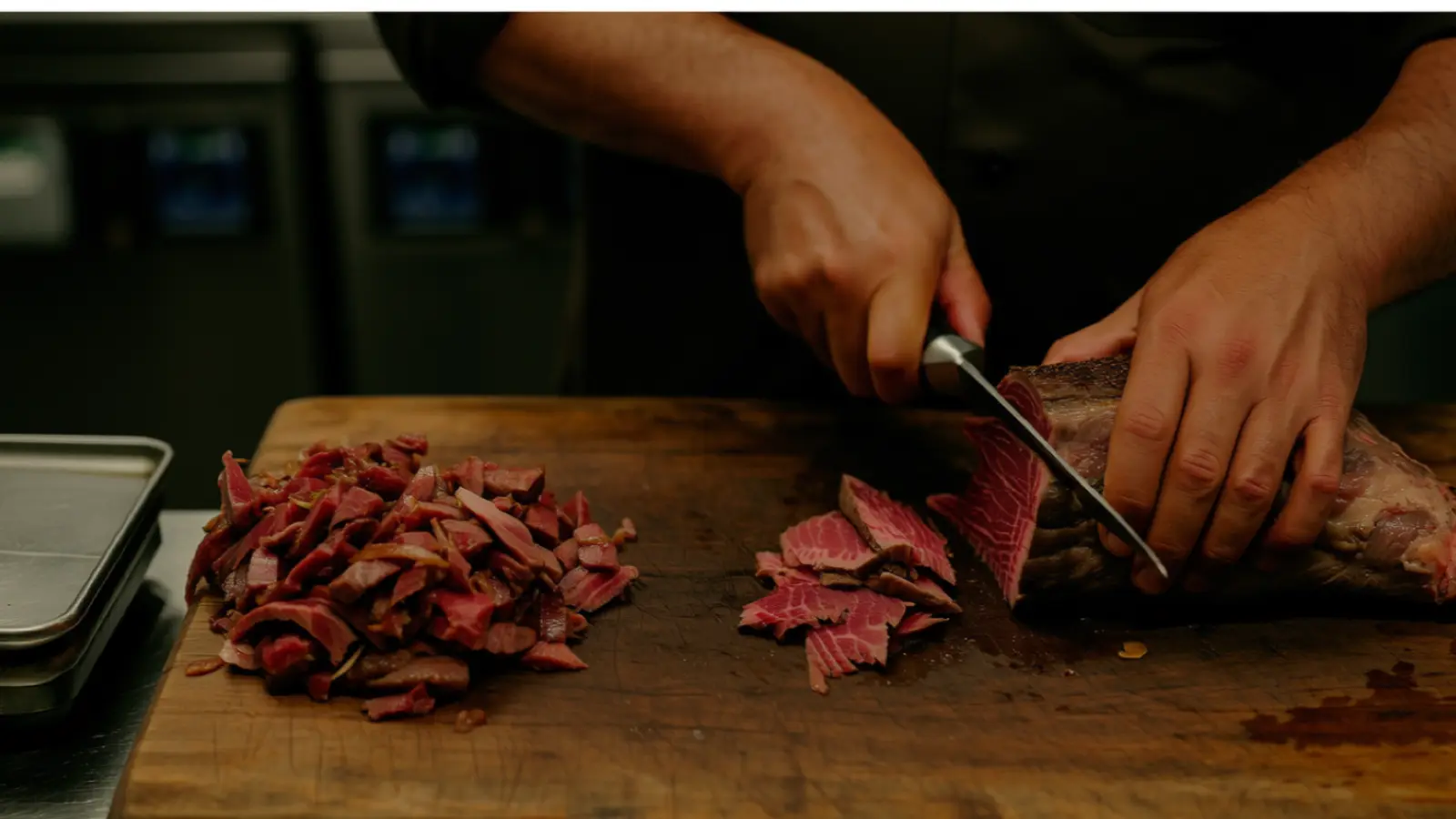
Prime cost is your cost of goods sold (food and beverage) plus your total labor cost, expressed as a percentage of sales. The working band across the industry is 55–65% of sales, with 60% the usual target (7shifts, Restaurant365). It's the number worth watching weekly because it's the only huge line on your P&L you can actually move — rent is signed, utilities are what they are, but food and labor respond to decisions you make this week.
Most operators track food cost and labor separately and miss what the combined number tells them. Your restaurant profit margin lives or dies on this one line: at a typical 3–5% net margin for full service, prime cost is twelve to twenty times your profit. Small movements in the big number dwarf big movements in the small ones.
The prime cost formula
Two traps. Labor means fully loaded labor — payroll taxes, benefits, your own salary if you work shifts — not just the wage line. And sales means net sales, before tax. A venue doing $1M with $290k in COGS and $330k in fully loaded labor runs a 62% prime cost. Inside the band, above the target.
What the benchmarks actually say
- Quick service: 55–60% — lighter labor, heavier packaging
- Fast casual: 58–63%
- Full service: 60–65% — the measured labor median alone hit 36.5% in the National Restaurant Association's FY2024 operator survey (900+ operators)
- Fine dining: often above 65% — the model carries it, barely
Treat every published figure as a target, not a census — nobody surveys the venues that quietly closed. The honest read: above 65%, the math of profit gets extremely hard; at or under 60%, you have room to breathe. And labor is drifting up everywhere — the same NRA survey has full-service labor up about 3.5 points versus a decade ago, and only about a third of operators hitting their own labor target (7shifts).
Two points of prime cost = 40% more sales
Here's the arithmetic that made me reorganize how Chat Noir runs. Take a $1M venue at 62% prime cost and 5% net margin — $50,000 of profit. Recover two points of prime cost and $20,000 drops straight to the bottom line: $70,000, a 40% jump in net profit. Getting that same $20,000 through growth at a 5% margin means finding $400,000 of new sales — 40% more covers, without adding a single seat. A cost point recovered is worth ten to thirty sales points at typical margins.
That's why prime cost rewards weekly attention. On a monthly P&L, a bad three weeks is already paid for. Weekly, a drifting number is one supplier invoice or one over-scheduled Saturday — findable and fixable while it's still small.
What watching it daily looks like
At Chat Noir, my club in Geneva, the Lightspeed register syncs into methodus every morning — 18 months and CHF 3.3M of sales so far. I don't reverse-engineer prime cost from a quarterly accounting export anymore; the COGS half of the number updates itself as sales land against costed recipes. The lesson transfers regardless of tooling: shorten the loop between the week you cook and the week you know.
Where the two points usually hide
- Recipes costed at last year's supplier prices — the quiet COGS leak
- Theoretical vs actual food cost variance of 3–5 points (common across the industry) — waste, portioning, the walk-in
- Overpouring behind the bar — audit data puts it around 15% of what's poured
- Scheduling built on habit instead of covers — the labor half of the line
Each of those is its own fix — we cover the food cost variance and the bar's version of the leak separately. The discipline is the same: cost every item, keep the costs current, and read the combined number every week — on the same morning dashboard as your sales.